
The Joomla and VirtueMart stack holds around 1.7 percent of the open e-commerce CMS market. New projects are better off starting on PrestaShop, OpenCart, or WooCommerce, and owners of working shops on VirtueMart should not rush a migration to another CMS before a stable VirtueMart 5 release.
Where the Joomla and VirtueMart stack stands now
Joomla holds 1.4 percent among all websites in the world; according to W3Techs, that is a drop of around 80 percent over the past ten years.
BuiltWith statistics
| Platform | Active domains | Share of open segment |
|---|---|---|
| OpenCart | 16,291 | 48.6% |
| WooCommerce | 13,839 | 41.3% |
| PrestaShop | 984 | 2.9% |
| JoomShopping (Joomla) | 664 | 2.0% |
| VirtueMart (Joomla) | 557 | 1.7% |
Source: BuiltWith. OpenCart and WooCommerce together hold around 90 percent of the open segment, VirtueMart and JoomShopping together under 4 percent.
Why VirtueMart is losing ground
VirtueMart is developed in an SVN repository, not on GitHub, so outside developers cannot participate. The single active core developer is Max Milbers ("Milbo" on the forum), and if he stops maintaining it, development may halt. OpenCart and PrestaShop have open GitHub repositories, and WooCommerce has thousands of active contributors. Security updates for VirtueMart are released mostly after a vulnerability is discovered (the last notable release, 4.6.0, came out with the telling name "We put on the helmet").
Joomla 6 was released as a stable build in October 2025. VirtueMart 4.x is fully incompatible with it, and VirtueMart 5 is in beta. The new version requires PSR-4 namespace, Composer autoload, and the replacement of jQuery and Fancybox with vanilla JavaScript, meaning all outside extensions will need to be rewritten or removed.
B2B positioning for VirtueMart
B2B buyers want to receive invoices automatically, without lengthy exchanges with managers.
| B2B feature | VirtueMart | OpenCart | PrestaShop | WooCommerce |
|---|---|---|---|---|
| Pricing by customer group | Support at database level | Native support | Native toolset | Requires paid plugins |
| B2B documents (invoices, completion certificates) | Requires plugin development | Basic invoices out of the box | PDF generation via Symfony templates | Requires specialist plugins |
| Cart for passing billing details without payment | Configurable via "Bank Transfer", collecting billing file attachments is problematic | Available out of the box | Available out of the box | Available via plugins |
| BAS integration | Needs custom development, no maintained modules | REST API connectors | REST API connectors | Solutions exist but often break on updates |
| API (shipping labels, cash on delivery) | No stable modules for Joomla | Stable, maintained module | Paid Pinta Webware modules with full API cycle | "WCUkrShipping" |
| Document workflow for B2B | Needs integration | Supported | Supported | Via plugins |
Risks of migrating to a new CMS from an SEO perspective
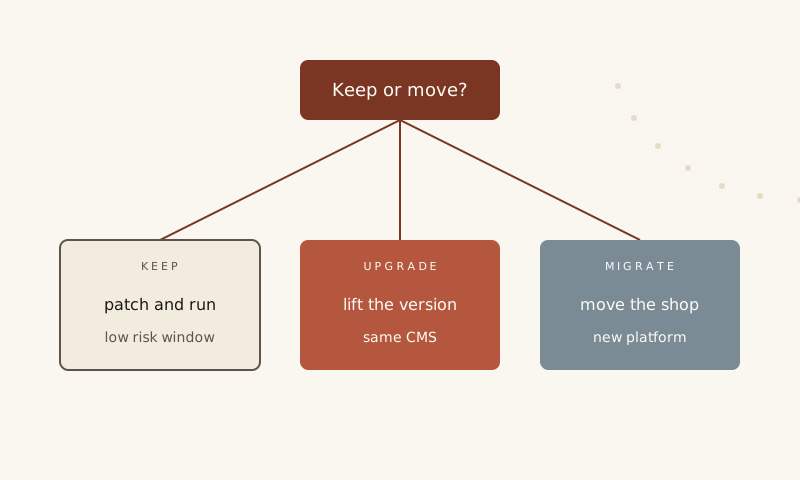
Migrating to a new CMS without understanding the risks is one way to destroy several years of SEO work. Read the material on migration from Joomla and VirtueMart.
According to ThatWare, the typical drop in organic traffic when migrating to a new CMS reaches 40 percent in the first six months, even with qualified specialists involved. Search Engine Journal: average stabilisation time is around 23 days, and 12 percent of sites do not return to their pre-migration traffic levels even a year later.
Each platform has its own URL logic: VirtueMart generates addresses in the format /categoryname/productnamedetail.html, WooCommerce /product/productname/, PrestaShop /categoryidname/productidname.html. Recovering a URL structure already in Google's index is difficult, and building a redirect map takes around two days of SEO specialist work.
What breaks when switching CMS
- Canonical: new URLs may be accessible via more than one address, and Google will index duplicates.
- Hreflang: the new CMS may change language prefixes.
- Schema.org: VirtueMart templates do not carry structured markup over to the new site.
- Sitemap: the sitemap on a new CMS is often full of surprises.
- 404: when a product is deleted, VirtueMart shows the parent category page with a 200 status code; after migration OpenCart may behave the same way.
Cost and the developer market

Choosing a CMS is choosing the long-run cost of your shop: hosting, modules, a developer, your own time. VirtueMart wins only on a lower barrier to entry ("an update" rather than "a new site"). For comparison: OpenCart has over 1,500 freelancers and agencies (response within 12 hours), PrestaShop around 180 specialists (within 24 hours), WooCommerce over 5,000 (within 4 hours).
When to stay on your current CMS and when migration is unavoidable

We are staying on Joomla and VirtueMart for now: the B2B specifics of our online shop were developed over more than fifteen years. While it works, let it work.
When to delay migration away from VirtueMart
- Stable SEO rankings in search results. The shop holds positions on key queries.
- B2B specifics. The shop is automated for B2B (invoice generation with VAT, delivery notes, shipping labels for postal operators).
- Software security. The shop runs on current versions of the CMS, components, and plugins maintained by their developers.
You should clearly leave VirtueMart if:
- GSC shows many "Duplicate, Google chose different canonical" errors and you cannot fix them with the native Joomla and VirtueMart tools.
- Managers enter shipping labels manually or synchronise stock levels by hand.
- 404 errors are not working in VirtueMart (a deleted product shows the parent category).
- The shop is slow; testing at https://pagespeed.web.dev/ shows at least one red indicator.
Learn about shop modernisation without losing SEO.
Questions and answers
Should you migrate away from VirtueMart?
If organic search positions are stable, you have a developer, and a working document workflow, there is no need to rush. If chronic indexation problems (404s, duplicates) and delivery service integration issues have piled up, then yes.
Why are there so few VirtueMart developers?
Core development is not on GitHub, which holds little interest for developers. The small market does not justify specialisation.