An owner of an online shop on Joomla and VirtueMart who wants to change CMS (usually because of technical SEO problems) hears the same advice from "experts": "move to Shopify" or "move to Magento, it runs fast, pure e-commerce, no blog, modern."
About Shopify
For a VirtueMart shop that runs on its own hosting, OpenCart is the natural neighbour. Same PHP, same VPS, same developer culture.
Shopify is a monthly fee plus a percentage of sales, and you do not deal with the technical side of the shop. If technical SEO does not interest you, it is a reasonable choice with stable support. Plans start at around forty euros per month (Basic) and go up to several hundred, plus transaction fees if Shopify Payments is not used, plus one and a half to two percent of each sale, plus monthly subscriptions for SEO, custom fields, invoice generation, accounting integrations. For an EU shop accepting Redsys, Bizum, Klarna, or LiqPay in Ukraine, over several years the total adds up to a sum that could have been spent once on a quality VirtueMart modernisation, or on a one time migration to OpenCart with only hosting to pay afterwards.
Redsys and Bizum are not all integrated (some work only through third party paid apps), and complex business processes require Shopify Plus (much more expensive). Shopify fits when you do not want to deal with technical issues and are ready to pay rent for that: you do not own the shop, and if anything happens you cannot take it with you. For a VirtueMart shop that has reached the point of needing to migrate, these conditions are usually not met.
About Magento
Magento is a CMS for shops with a large and complex product catalogue, and in that niche it has no competitors. VirtueMart shops, by objective data, almost never operate in that niche. Magento 2 requires Elasticsearch or OpenSearch, Redis, and RabbitMQ as mandatory components (not "recommended for performance", mandatory), hosting is much more expensive than a standard VPS, and each major upgrade is a new small project of testing and adapting extensions. The VirtueMart owner has neither the team, the desire, nor the money for that every year and a half. According to StoreLeads, the active Magento Open Source shop base shrank from around 160 thousand at the end of 2021 to 112 thousand in the first quarter of 2026: Magento lives and grows in enterprise. We migrate clients to Magento when they are in that niche, but for a VirtueMart shop it is almost always excessive.
About OpenCart
For the shop described above, my choice is OpenCart. Not because it is fashionable or trending, but because it matches your reality: the same PHP, the same VPS or cPanel hosting.
OpenCart 4.x is the main line with regular releases and patches, maintained around project founder Daniel Kerr, with active GitHub, security patches, and a community forum and marketplace (the 3.x line gets only maintenance updates). Version 4 dropped the OCMod mechanism (XML search and replace on core files) in favour of an Event System that fires before and after controller actions without touching the core. It requires PHP 8.1 minimum and runs on 8.2 and 8.3, Bootstrap 5 in the admin, no Elasticsearch or Redis, just PHP and MySQL or MariaDB. The same stack your VirtueMart already runs on.
An inconvenient fact: according to StoreLeads, active OpenCart shops fell from around 225 thousand at the start of 2024 to 160 thousand by the end of the third quarter of 2026, minus thirty percent over two and a half years. Development is active, extensions are released, the CMS is stable, and the trend does not mean OpenCart is dying. Choose a CMS based on the task at hand, not on hype. For reference: Magento in SMB is declining at a comparable rate, PrestaShop and WooCommerce are losing share to Shopify and BigCommerce.
About Joomla and VirtueMart
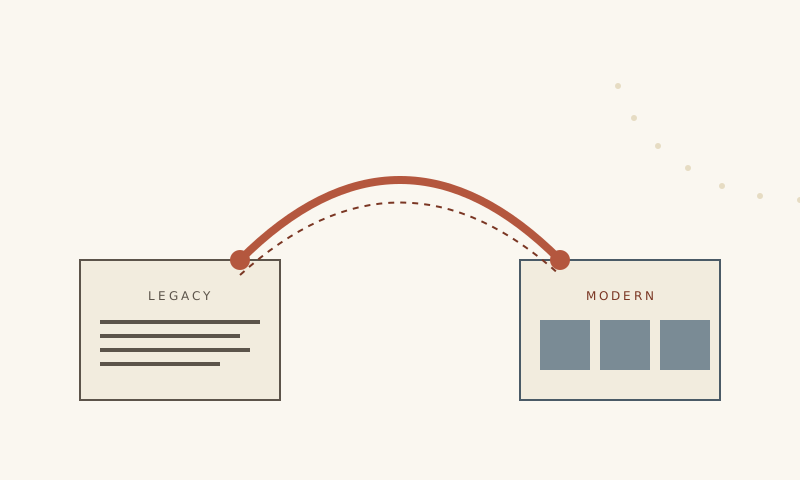
VirtueMart on Joomla 5 continues to receive updates, runs on PHP 8, and works adequately with several thousand product cards. Main reasons owners consider switching CMS: slow loading; difficulty meeting modern technical SEO requirements (markup for LLM, language tags, correct 404 handling in VirtueMart where the derived URL text of a product category returns 200); the shop cart in a default configuration long out of date; extensions whose developers stopped supporting them; the feeling that "the site looks like 2012."
All of this can be solved without changing CMS: update PHP, remove unsupported (that is, dangerous) extensions, change the template, work on Core Web Vitals, add Schema.org, modernise the cart checkout. This is our specialisation, and in most cases it is enough. Detail on our Joomla and VirtueMart modernization page. Migration becomes unavoidable when the problem is genuinely in the CMS, not in the shop's technical SEO. VirtueMart is our strong suit, we are equally interested in both modernisation and migration to OpenCart.
Why OpenCart 4 suits the typical VirtueMart shop
Same infrastructure (runs on your current hosting with PHP 8 and MySQL or MariaDB); OpenCart Marketplace works on a single purchase model, pay for an extension once (big difference from Shopify); full control over database and file system, you own the shop in the same sense you own VirtueMart now; native support for several separate storefront domains from one admin panel, with separate templates, catalogue, pricing, and languages.
Migration from VirtueMart to OpenCart 4: technical side and pitfalls
Architecture and design. VirtueMart is a component inside Joomla, using Joomla database, ACL, routing, templates, and plugins. OpenCart has its own database, catalogue structure, and templates, and your current Joomla template does not migrate. The design must be rebuilt on an OpenCart template.
Products and categories. VirtueMart uses a parent child model: a product has a parent category, SKU, stock, price, and unique URL. OpenCart differs: a product is one database record. If separate SKUs and unique URLs for each product variant matter to you (ads, Google Shopping feeds, separate analytics), that logic must either be developed for OpenCart or accepted as working differently.
Customers, groups, and B2B prices. VirtueMart shopper groups (for example, wholesale customers with different prices) migrate as OpenCart customer groups without problems. Pricing logic differs: VirtueMart ties prices to complex calculation rules, OpenCart uses simpler discount rules, and all current pricing rules must be rebuilt.
Customer passwords. VirtueMart uses Joomla authentication with BCrypt or Argon2id. OpenCart historically uses a different hashing mechanism, so by default the hashes do not work, customers get an error on login, and automatic migration tools do not solve this. The fix: either a login module for OpenCart that recognises the old Joomla hash on the first successful login, or new passwords for all customers after migration with an email notification.
Order history. Orders, order lines, statuses, and totals migrate, but VirtueMart and OpenCart number statuses differently. Without an explicit mapping the script places orders into status zero, and the admin cannot see which were fulfilled, cancelled, or in progress. Before migration, build a correspondence table between VirtueMart and OpenCart order statuses (creating any missing ones in OpenCart) and add it to the script. VirtueMart often stores the final order total as a single complex record mixing discounts, tax, and shipping, while OpenCart splits this into separate lines.
URLs and 301 redirects. Your current VirtueMart URLs such as /shop/category/product.html do not match the OpenCart URL structure. Automatic tools transfer products and categories, but old URLs become example.com/index.php?route=product/product&product_id=X or the SEO friendly example.com/product-name (depending on OpenCart settings). Order of work: before switching DNS, export all indexed URLs, build a redirect map from old to new, configure .htaccess (or OpenCart Redirect Manager) with 301 redirects, then switch DNS. No automatic tool does this for you.
Joomla articles and MijoShop. Alongside the shop in Joomla typically live a blog, "About us" pages, FAQ, landing pages, contact page, and menus. OpenCart is only a shop, so this content does not transfer. MijoShop (OpenCart engine embedded inside Joomla as a component) lets you keep the Joomla environment around an OpenCart shop and has existed for years, but activity is noticeably declining, updates are rarer, and the extension marketplace is sparse. Only for temporary or very specific cases.
Changing CMS: what happens to SEO
Any CMS change affects SEO metrics, and migrating to OpenCart is no different from Shopify or Magento in this respect. URL structure, HTML markup, loading speed, internal linking, sitemap, and robots.txt all change. Google and other engines see this as a significant change and recalculate page rankings from scratch. Usually this is a temporary fluctuation lasting several weeks; with a poorly executed migration the drop stretches to months.
When OpenCart is not suitable
Complex filters on category pages. OpenCart in standard configuration relies on MySQL queries with runtime joins across the oc_product_attribute, oc_product_option_value, and oc_category_path tables. Above several thousand SKUs (especially with many filters per product), MySQL starts doing full table scans and disk temporary tables, and performance degrades. The standard solution is an external search backend (Elasticsearch or MeiliSearch), but that already brings OpenCart to Magento level complexity, at which point it makes more sense to look directly at Magento.
Joomla content inseparable from the shop. If your blog, articles, and landing pages are an active marketing system integrated with VirtueMart (articles pull in product cards automatically, landing pages show shop offers dynamically, blog categories are linked to product categories), running "Joomla as CMS plus OpenCart as shop in parallel" requires complex integration work. Stay on VirtueMart.
What to do next
Three options: modernise VirtueMart without migrating; migrate to OpenCart; migrate elsewhere (Shopify, Magento, WooCommerce).
VirtueMart modernisation. Our standard service. Detail on the Joomla and VirtueMart modernization page. Result: the same VirtueMart running in line with modern requirements, with full history and SEO reputation preserved, without migration.
Migration to OpenCart. Our standard service: technical SEO audit; 301 redirect setup; product transfer with VirtueMart to OpenCart mapping (child products, SKUs, old URLs preserved on the new site, login module for customers with old passwords, order status mapping with correct history transfer); OpenCart template customisation; EU VAT and GDPR through tested extensions; payment integrations (Redsys, Bizum, Klarna, Stripe, PayPal, LiqPay, Nova Poshta, whatever you need); monitoring for the first six weeks with targeted fixes.
Frequently asked questions
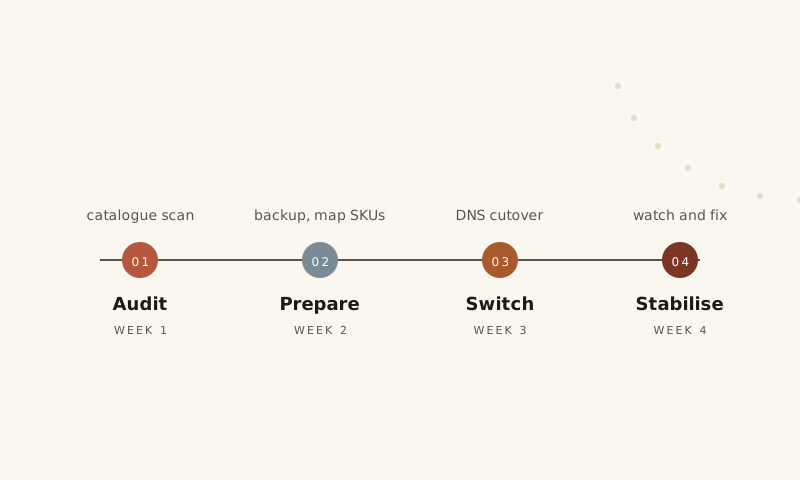
How long does migration take? Standard is up to four weeks.
What happens to my current SEO positions? Temporary fluctuations.
Will old orders be on the new site? Yes, along with products, categories, and customers.
What happens to blog articles after the shop migrates? Leave Joomla as CMS for content and set up OpenCart in parallel (our standard pattern).
How does OpenCart 4 handle EU VAT and GDPR? Basic Tax Rates through Geo Zones work out of the box. Full EU VAT logic (One Stop Shop, VIES validation for B2B, reverse charge for intra community supplies) and GDPR compliance (cookie consent, forget me, data export on request) require paid extensions.
I have around seven thousand products. Will OpenCart work? Yes. OpenCart 4 in standard configuration on a decent VPS handles up to several tens of thousands of products.
Can I migrate myself with a ready made tool? Not advisable for a live business.
Related reading
- VirtueMart to Magento migration
- VirtueMart to Shopify migration
- SEO for VirtueMart: complete guide for 2026
- Kyiv Stend case: a working VirtueMart shop over eleven years in the Google index
Get in touch
We can discuss your situation. Write to us.
title: VirtueMart to OpenCart 4 Migration: Why OpenCart When Migration Is Unavoidable
meta description: When a VirtueMart shop needs a new CMS, OpenCart 4 usually fits better than Shopify or Magento. Same PHP and VPS stack, one time extension purchases, honest look at pitfalls.